Enterprises struggle with a lack of a unified PMO framework, leading to incomplete visibility into current and future capital investments, inefficient tracking of project spending, resource misallocation, and an inability to measure the effectiveness of software development efforts, resulting in financial waste and poor decision-making.
Many enterprises face significant challenges in managing their capital investments and overall project spending due to the lack of a comprehensive Project Management Office (PMO) framework. Without a well-structured PMO system, organizations struggle to gain full visibility into current and future capital spending, leaving them unable to track and control expenses across projects effectively.
- Lack of Visibility into Capital Investment: Enterprises often fail to see the entire picture of their capital investment portfolio. This results in scattered project funding, misaligned resource allocation, and budget overruns. Without real-time insights into the allocation and utilization of funds, decision-makers are unable to plan or adjust for future needs effectively.
- Disconnected Project Spend Tracking: Tracking project-related expenditures across various departments and business units is a challenge when there’s no unified system in place. This lack of visibility often leads to financial leakage, project delays, and poor forecasting, as it becomes difficult to link spend to specific outcomes.
- Inefficient Resource Utilization: Resources, including people and technology, are often inefficiently allocated due to the absence of a centralized tracking mechanism. Without proper visibility, enterprises find it hard to measure the utilization of resources across projects, leading to underperformance or over-allocation in some areas.
- Inability to Measure the Effectiveness of Software Development and Applications: Enterprises also lack mechanisms to measure the overall effectiveness of their software development efforts. This results in misaligned priorities, delayed rollouts, and challenges in achieving ROI from software investments. Without a clear performance measurement system, continuous improvement efforts often fall short.
Issues:
Fragmented Systems: Traditional PMO systems are often siloed, making it difficult to consolidate data across various projects, business units, and departments.
Manual Tracking: Many organizations rely on manual tracking systems, leading to errors, inefficiencies, and outdated reporting.
Budget Overruns: Poor tracking of project budgets and resource utilization often results in capital overruns and missed financial targets.
Reactive Decision-Making: With no proactive monitoring, businesses tend to react to problems after they arise rather than anticipate and prevent them.
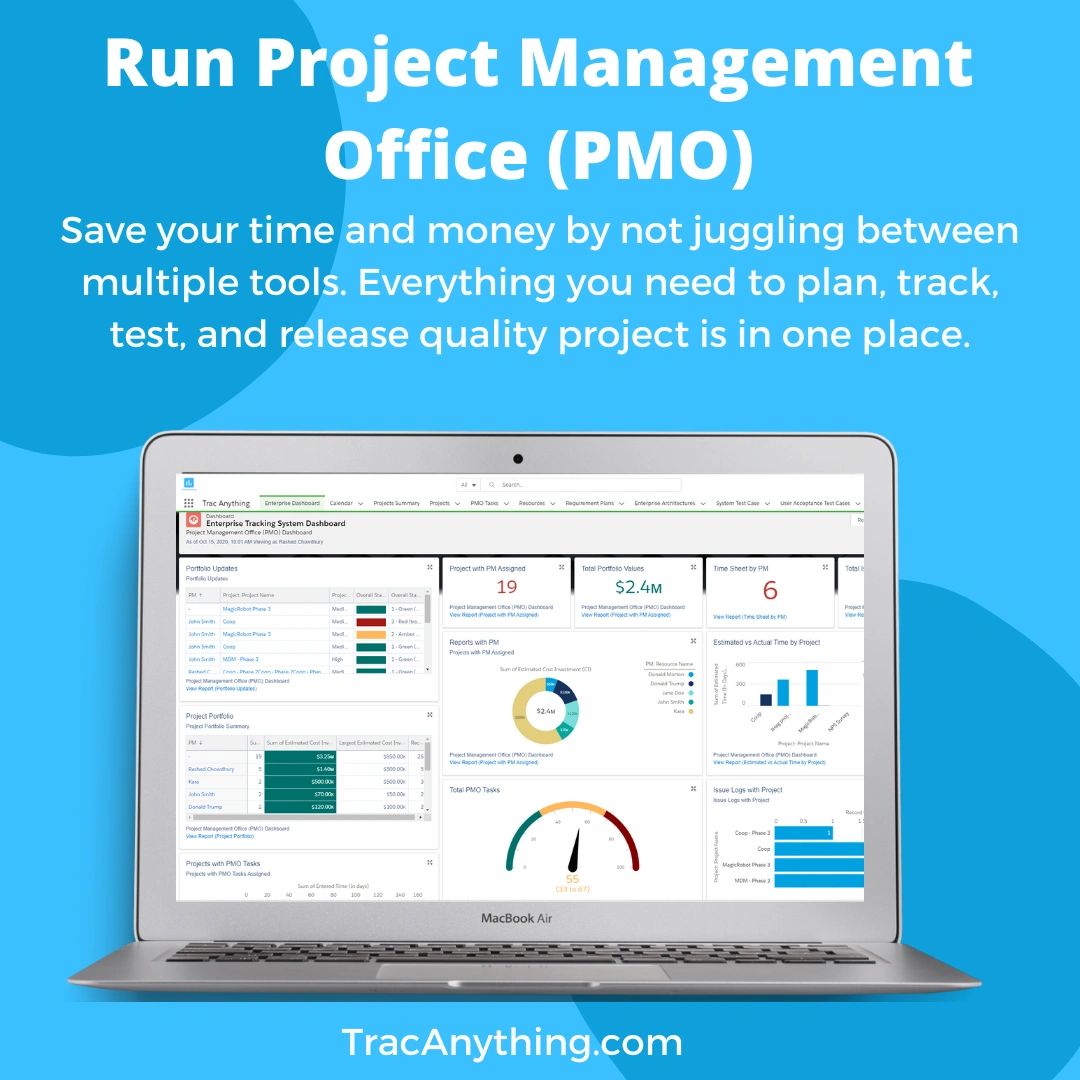
TracAnything by SalesHub solves this problem by delivering a comprehensive PMO and ERP solution that empowers enterprises with real-time visibility into their capital investments, project spending, and resource utilization. By unifying data across projects and departments, TracAnything enables smarter, data-driven decision-making, improves resource allocation, and maximizes ROI on software development and overall business operations. This solution streamlines financial management, ensuring enterprises can anticipate future needs, avoid budget overruns, and enhance overall project effectiveness.
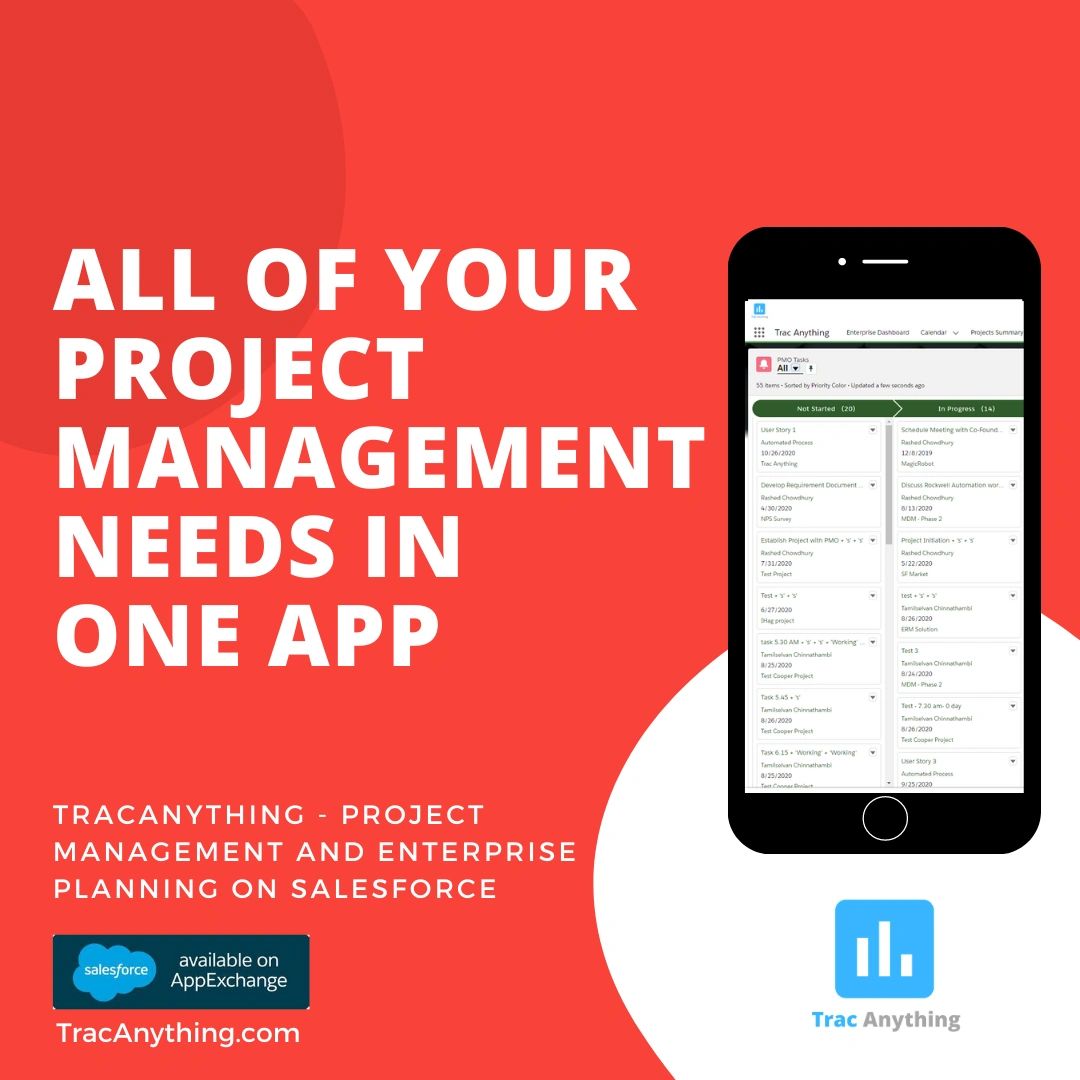
TracAnything is an AI-powered, comprehensive project management and PMO solution built on the Salesforce platform, designed to transform how businesses manage projects, track tasks, and achieve their goals.
Key Benefits & Features
- AI-Infused Project Management: Leverage AI to predict project risks, automate task assignments, and provide intelligent insights to enhance productivity.
- Comprehensive Reporting & Dashboards: Real-time visibility into project health, timelines, and resource allocation.
- Integration & Scalability: Seamlessly integrates with Salesforce and other tools, allowing your team to work within a unified platform.
- Adaptable Frameworks: Offers both Waterfall and Agile methodologies, accommodating varied project management styles.
Value Propositions by Stakeholder
- For Project Managers: Streamline task management, optimize resource allocation, and gain AI-driven insights to keep projects on track.
- For Executives: Obtain real-time, high-level visibility in project performance, ensuring meeting strategic goals.
- For Salesforce Admins: Simplify the integration process and data management with TracAnything’s seamless Salesforce compatibility.
Differentiators
- AI-Driven: The only project management tool on AppExchange that utilizes AI for predictive analysis and workflow automation.
- Comprehensive Governance: Incorporates BABOK, PMBOK, and IIBA frameworks for holistic project management.
- Hybrid Approach: Enables both traditional PMO governance and Agile methodologies.
Use Cases:
- Risk Management: Proactively identify and mitigate project risks using AI-powered insights.
- Resource Allocation: Optimize resource usage with predictive analytics, ensuring teams are never over or underutilized.
- Stakeholder Reporting: Provide detailed, real-time reports to stakeholders, ensuring transparency and accountability.
SalesHub's Project Management Framework, built on over two decades of industry expertise, serves as the foundation for developing TracAnything. This state-of-the-art framework integrates enterprise-grade PMO governance, combining methodologies such as BABOK and PMBOK with cutting-edge AI-driven insights. It streamlines project management by offering comprehensive visibility, real-time data integration, and seamless collaboration, enabling enterprises to track capital investments, optimize resource utilization, and make data-driven decisions that enhance overall project efficiency. TracAnything leverages this robust framework to deliver an unparalleled project management solution on the Salesforce platform.
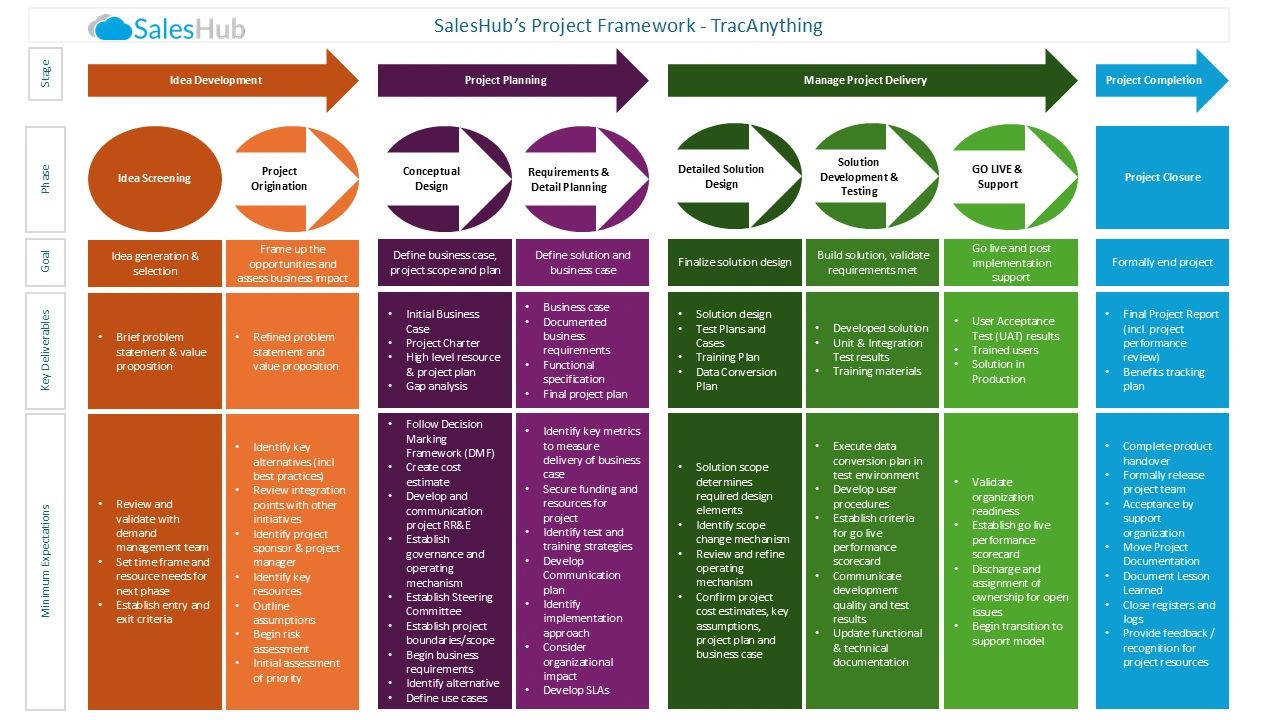
1. Idea Development (Idea Screening & Project Origination)
Steps:
- Identify the Use Case:
- Define the problem TracAnything solves (e.g., lack of project visibility, ineffective capital tracking, resource misallocation).
- Set key business objectives such as improving project tracking, increasing visibility, and managing resources efficiently.
- Leverage Salesforce's platform to enable tracking and reporting.
- Document Requirements:
- Collaborate with stakeholders (PMO, project managers, finance teams).
- Gather functional needs like data entry requirements, reporting, and integrations with other systems (e.g., ERP systems).
Deliverables:
- Problem Statement: Articulate the core issue (e.g., lack of visibility into capital investments).
- Value Proposition: How TracAnything solves the issue (e.g., AI-powered insights for project management).
- Refined Problem Scope: Scope the project in terms of Salesforce features required (custom objects, dashboards, integrations).
2. Project Planning (Conceptual Design & Requirements)
2.1 Conceptual Design
Steps:
- Define the Business Case:
- Use Salesforce’s Opportunity Object to track capital investments.
- Create a project plan using Salesforce Tasks and Project Management Apps from the AppExchange (e.g., Mission Control, Inspire Planner).
- Create Gap Analysis:
- Identify missing Salesforce features such as custom objects (e.g., Project, Resource Allocation) or custom workflows.
Deliverables:
- Business Case: ROI, cost-benefit analysis, and project scope.
- Solution Plan: Define high-level goals and milestones.
- Gap Analysis: Document missing custom objects, workflows, and integrations.
2.2 Requirements & Detailed Planning
Steps:
- Functional Specification:
- Define custom objects like Projects, Tasks, Resources, and their relationships.
- Specify fields required for tracking budget, milestones, and timelines.
- Security & User Roles:
- Define Profiles and Permission Sets for various users (e.g., Project Manager, Executive, Admin).
- Data Model Design:
- Use Salesforce Schema Builder to visually design the data model (custom objects, fields, and relationships).
Deliverables:
- Functional Specification: Define custom objects, workflows, and Apex code requirements.
- Data Model: Complete data model blueprint.
- Security Design: Profiles and permissions setup.
3. Manage Project Delivery (Solution Design & Development)
3.1 Solution Design
Steps:
- Architect the Solution:
- Use Salesforce Flow for automation (e.g., automated project approval process).
- For complex logic, use Apex Classes, Triggers, and LWC (Lightning Web Components).
- Design Data Migration:
- Create a data migration strategy using Salesforce Data Loader or MuleSoft for integrations.
Deliverables:
- Solution Design Document: Include architecture, security, and integration plans.
- Test Plan: Detailed test plans for unit, system, and integration tests.
3.2 Solution Development & Testing
Steps:
- Configuration:
- Set up Salesforce custom objects (e.g., Project, Tasks, Budget), validation rules, and workflows.
- Code Development:
- Develop custom Apex code or LWC for advanced functionality.
- Ensure Test Class coverage for unit tests.
- Test the Solution:
- Execute test cases (UAT, unit testing) using Salesforce Test Class Framework and log results in Salesforce.
Deliverables:
- Developed Solution: Complete custom objects, workflows, UI components, and code.
- Test Results: Capture UAT, system testing outcomes.
4. Manage Project Delivery (Go-Live & Support)
Steps:
- Train Users:
- Conduct training sessions using Salesforce Knowledge and Trailhead modules.
- Provide documentation on how to use TracAnything.
- Deploy Solution:
- Use Change Sets or Salesforce DevOps to deploy objects, Apex code, and configurations from sandbox to production.
- Go-Live:
- Launch the solution in production and track user adoption using Salesforce reporting.
Deliverables:
- Trained Users: Completion of training.
- Go-Live Checklist: Checklist for deployment validation.
- Support Plan: Define a support model using Salesforce Cases or third-party ticketing systems.
5. Project Closure
Steps:
- Document Lessons Learned:
- Conduct a retrospective with stakeholders and document key learnings for future releases.
- Complete Handover:
- Provide handover documents, including architectural diagrams, configuration steps, and codebase.
Deliverables:
- Final Project Report: Include key metrics such as project success, user feedback, and post-implementation issues.
- Formal Project Closure: Signed-off handover to support/maintenance team.
SalesHub’s Project Management Framework is the backbone of the TracAnything solution, enabling the development of a powerful, adaptable tool on the Salesforce platform. By incorporating both Agile and Waterfall methodologies, the framework provides a hybrid approach that allows for flexibility and structure, depending on project needs. Leveraging PMBOK, BABOK, and IIBA best practices, this framework ensures comprehensive governance, accurate resource management, and real-time visibility into project health. TracAnything is designed to meet the complex demands of modern enterprises, blending industry-standard project management principles with the dynamic capabilities of the Salesforce ecosystem for superior results.